Tuesday, October 27, 2009
Apple Tree Diner WJAR 10 Coverage
Students at Smithfield High School, Smithfield, RI. are excited about their upcoming diner restoration project. WJAR Channel 10 covered the move of the formerApple Tree/ Midway Diner. Click here for coverage.


Thursday, September 24, 2009
Smithfield students restore 1930s diner
Smithfield students restore 1930s diner
45 students will work together on restoration
Published : Thursday, 17 Sep 2009, 12:45 AM EDT
Smithfield, R.I. (WPRI) - High school students in one local district come together to restore a piece of history.
Students at Smithfield High School have decided to restore a 1930's diner as part of a new service project.
Officials from the American Diner Museum delivered the remnants of what once was Quincy's Midway Diner to school grounds on Wednesday to kick off the project.
45 students will work for two years to restore the property on campus.
Smithfield Teacher Jeff Macari says the project will involve many departments within the school. In addition to the restoration team students from the art, business, and consumer science departments will also play a role in the efforts.
School officials are working to secure grants and community donations to fund the project. An initial estimate shows the construction will cost at least 50,000 dollars.
Once completed the school plans to use the diner as a unique concession stand outside the football field.
Friday, May 15, 2009
CN8 New Hope Diner Project Video
Please watch the story of the New hope Diner Project from Comcast Cable.
Wednesday, March 18, 2009
Hickey's Diner 1954 Chevrolet COE has arrived.The restoration has began on the cabover and engine for the truck that will carry Hickey's Diner.


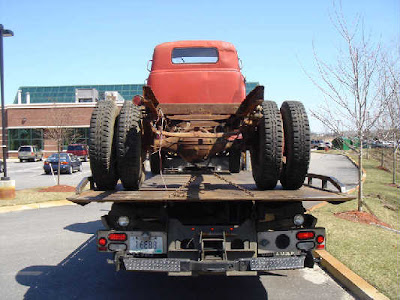
 COLETTA'S COLLISION CENTER will be assisting us with the restoration of our Chevrolet truck for Hickey's Diner. We will post photos as soon as they are available.
The restoration of the engine for our 1954 COE is almost complete..


 Students at New England Tech inspect the engine that will go into
the COE.


Students at New England Tech in Warwick, RI. and Coletta's Garage will under take the restoration of our truck.
If you would like to offer assistance be it technical or financial with the restoration of our COE, please email the museum at HickeysDiner@AmericanDinerMuseum.org
We will be listing parts needs as we get further into the project..


Our 1954 Cheverolet COE for Hickey's Diner has arrived and restoration has begun...
Sunday, March 01, 2009
The New Hope Diner Project Receives its First Award!
Congratulations to John Scott and the New Hope Diner Project for being the recipients for the New England Council on Crime and Delinquency's 2008 John R. Manson/Carl Robinson Award.
This award honors an individual who has truly made a significant contribution to the field of Criminal Justice within the New England area. The award is named for two outstanding New England professionals:
John R. Manson served the State of Connecticut as Commissioner of Corrections until his death in 1983. He had a long and distinguished career and was credited with initiating major reforms in the State’s prison system.
Carl Robinson was also a pioneer in prison reform in the State of Connecticut where he served as Warden of Somers State Prison. In 1982 he was honored by the A.C.A. as the “National Warden of the Year”.
This award honors an individual who has truly made a significant contribution to the field of Criminal Justice within the New England area. The award is named for two outstanding New England professionals:
John R. Manson served the State of Connecticut as Commissioner of Corrections until his death in 1983. He had a long and distinguished career and was credited with initiating major reforms in the State’s prison system.
Carl Robinson was also a pioneer in prison reform in the State of Connecticut where he served as Warden of Somers State Prison. In 1982 he was honored by the A.C.A. as the “National Warden of the Year”.
Thursday, February 05, 2009
New Hope Brand Coffee's Favorite Roaster May Also Be Our Favorite Barista!
New Hope Brand Coffee's Favorite Roaster May Also Be Our Favorite Barista!
As you may know New Harvest Coffee Roasters is the roaster of our New Hope Coffee. Well one of our roasters is also one "HECK OF A BARISTA"!
Devlin Rice will be competing in the Specialty Coffee Association of America's Northeast Regional Barista Competition in Pittsburgh this week. He has been working tirelessly perfecting his techniques and hisfabulous specialty drink for the competition.
I was invited by Gerra Harrigan of New Harvest Coffee Roasters to sit on two of several his review panels with some of Rhode Island's most respected coffee, food,and pastry artisans (I have to admit I was a bit Star Struck). When I walked in for the first time and sat next to the owners of Coffee Exchange and Seven Stars Bakery I though I was in the wrong room!
One behalf of the New Hope Diner Project I want to congratulate Rik Kleinfeldt owner and Gerra Harrigan Director of Business Development of New Harvest Coffee Roasters...
But most of all we want to wish Devlin Rice the best of luck and we are all behind you.
FYI whenever you need someone to sample your creations just let me know. Here is the link to read the whole story: http://tinyurl.com/dflb35
As you may know New Harvest Coffee Roasters is the roaster of our New Hope Coffee. Well one of our roasters is also one "HECK OF A BARISTA"!
Devlin Rice will be competing in the Specialty Coffee Association of America's Northeast Regional Barista Competition in Pittsburgh this week. He has been working tirelessly perfecting his techniques and hisfabulous specialty drink for the competition.
I was invited by Gerra Harrigan of New Harvest Coffee Roasters to sit on two of several his review panels with some of Rhode Island's most respected coffee, food,and pastry artisans (I have to admit I was a bit Star Struck). When I walked in for the first time and sat next to the owners of Coffee Exchange and Seven Stars Bakery I though I was in the wrong room!
One behalf of the New Hope Diner Project I want to congratulate Rik Kleinfeldt owner and Gerra Harrigan Director of Business Development of New Harvest Coffee Roasters...
But most of all we want to wish Devlin Rice the best of luck and we are all behind you.
FYI whenever you need someone to sample your creations just let me know. Here is the link to read the whole story: http://tinyurl.com/dflb35
Saturday, November 29, 2008
New Hope Coffee Available for Holiday Giving.
It's that time again!!!!! Please keep New Hope Coffee in mind for your holiday gift giving. We are taking orders now for your holiday gift giving. To place your order go to the American Diner Museum website (click on the New Hope Coffee link on the right to place your order) New Hope Brand Coffee comes in: New Hope Coffee Regular Ground and Regular Whole Bean $11.00 per pound or 2 pounds for $20.00 New Hope Coffee Decaffeinated Ground and Decaffeinated Whole Bean $12.00 per pound or 2 pounds for $22.00(Checks must be made payable to: American Diner Museum)
New Hope Coffee is a great gift idea because with each pound you buy you are giving multiple gifts. First, all profits from the sale of New Hope Coffee go directly back into the New Hope Diner Project to buy materials for our self-sustaining program that provides educational and vocational opportunities to the youth in the care of the Department of Children, Youth & Families, Division of Juvenile Correctional Services.
Second, New Hope Brand Coffee is Certified Fair Trade. Fair Trade Certification empowers farmers and farm workers to lift themselves out of poverty by investing in their farms and communities, protecting the environment, and developing the business skills necessary to compete in the global marketplace.
When you buy New Hope Brand Coffee for the coffee drinker on your shopping list you are also helping to provide for the coffee growers in third world countries a living wage and helping them develop a stronger economic structure in their country.
Third, New Hope Brand Coffee is locally roasted. New Harvest Coffee Roaster is our roaster located in Pawtucket, RI. and by supporting the New Hope Brand Coffee you are also supporting the local economy by supporting a socially conscious, small batch specialty coffee roaster here in Rhode Island.
Finally, New Hope Brand Coffee is always fresh. New Hope Brand Coffee is a perfect blend of bright lively Central American beans complemented with undertones of dark caramel and a dash of dark roast. There is a complex aroma of dried fruit and cinnamon, followed by a light-bodied brew that suggests sweet cider with a hint of citrus.
New Hope Coffee is a great gift idea because with each pound you buy you are giving multiple gifts. First, all profits from the sale of New Hope Coffee go directly back into the New Hope Diner Project to buy materials for our self-sustaining program that provides educational and vocational opportunities to the youth in the care of the Department of Children, Youth & Families, Division of Juvenile Correctional Services.
Second, New Hope Brand Coffee is Certified Fair Trade. Fair Trade Certification empowers farmers and farm workers to lift themselves out of poverty by investing in their farms and communities, protecting the environment, and developing the business skills necessary to compete in the global marketplace.
When you buy New Hope Brand Coffee for the coffee drinker on your shopping list you are also helping to provide for the coffee growers in third world countries a living wage and helping them develop a stronger economic structure in their country.
Third, New Hope Brand Coffee is locally roasted. New Harvest Coffee Roaster is our roaster located in Pawtucket, RI. and by supporting the New Hope Brand Coffee you are also supporting the local economy by supporting a socially conscious, small batch specialty coffee roaster here in Rhode Island.
Finally, New Hope Brand Coffee is always fresh. New Hope Brand Coffee is a perfect blend of bright lively Central American beans complemented with undertones of dark caramel and a dash of dark roast. There is a complex aroma of dried fruit and cinnamon, followed by a light-bodied brew that suggests sweet cider with a hint of citrus.
Tuesday, September 30, 2008
October is Fair Trade Month and New Hope Brand Coffee is Fair Trade Certified!
The Month of October is Fair Trade Month and New Hope Brand Coffee is Fair Trade Certified!
Come Visit the New Hope Diner Project
41st Scituate Arts Festival
Columbus Day Weekend October 11-13, 2008
(In front of the Country Gardener ~ 617 W Greenville Rd ~ North Scituate, RI)
Please be sure to visit the New Hope Brand Coffee Booth at the 41st Annual Scituate Arts Festival and say hello. Admission is free and is open from 10:00 AM to 5:00 PM. Last year was New Hope Coffee's first year at the Scituate Arts Festival and thanks to your support the New Hope Diner Project exceeded it sales goal selling 200 lbs of coffee. Come visit us again at our location next door to the North Scituate Baptist Church located at 619 West Greenville Road (also known as Route 116) in North Scituate, Rhode Island and help us exceed our goal again this year!
About New Hope Brand Coffee and the New Hope Diner Project
New Harvest Coffee Roasters (www.newharvestcoffee.com) in Pawtucket, RI helped us create New Hope Brand Coffee. New Hope Brand Coffee is a perfect blend of bright lively Central American beans complemented with undertones of dark caramel and a dash of dark roast. There is a complex aroma of dried fruit and cinnamon, followed by a light-bodied brew that suggests sweet cider with a hint of citrus. New Hope Brand Coffee is Certified Organic and Certified Fair Trade.
In 1872 Walter Scott first offered coffee from his lunch wagon to customers on the streets of Providence, Rhode Island. He unknowingly inspired the creation of an industry that would later become an American icon, the diner.
In the entrepreneurial spirit of Walter Scott, the Department of Children, Youth & Families, Division of Juvenile Correctional Services, Bryant University, the American Diner Museum, and Struever Bros. Eccles & Rouse has been working with a disadvantaged youth population through the restoration of historic American Diners. This collaboration provides educational, vocational and employment opportunities to the youth in the care of the Department of Children, Youth & Families, Division of Juvenile Correctional Services. All proceeds from coffee sales go to the New Hope Diner Project to buy materials. The New Hope Diner Project is a self-sustaining program that was created to provide educational, vocational, and employment opportunities to the youth in the care of the Department of Children, Youth & Families Division of Juvenile Correctional Services. On Sunday October 12th meet Miss Rhode Island America, Francesca Simone at our New Hope Coffee booth from 11:00AM to 1:ooPM.
The Fair Trade Certified* label guarantees consumers that strict economic, social and environmental criteria were met in the production and trade of an agricultural product. Fair Trade Certification is currently available in the U.S. for coffee, tea and herbs, cocoa and chocolate, fresh fruit, flowers, sugar, rice, and vanilla. TransFair USA licenses companies to display the Fair Trade Certified label on products that meet strict international Fair Trade standards.Fair Trade Certification empowers farmers and farm workers to lift themselves out of poverty by investing in their farms and communities, protecting the environment, and developing the business skills necessary to compete in the global marketplace. Fair Trade principles include:
1. Fair prices: Democratically organized farmer groups receive a guaranteed minimum floor price and an additional premium for certified organic products. Farmer organizations are also eligible for pre-harvest credit.
2. Fair labor conditions: Workers on Fair Trade farms enjoy freedom of association, safe working conditions, and living wages. Forced child labor is strictly prohibited. Direct trade: With Fair Trade, importers purchase from Fair Trade producer groups as directly as possible, eliminating unnecessary middlemen and empowering farmers to develop the business capacity necessary to compete in the global marketplace.
3. Democratic and transparent organizations: Fair Trade farmers and farm workers decide democratically how to invest Fair Trade revenues. Community development: Fair Trade farmers and farm workers invest Fair Trade premiums in social and business development projects like scholarship programs, quality improvement trainings, and organic certification. 4. Environmental sustainability: Harmful agrochemicals and GMOs are strictly prohibited in favor of environmentally sustainable farming methods that protect farmers' health and preserve valuable ecosystems for future generations.
Come Visit the New Hope Diner Project
41st Scituate Arts Festival
Columbus Day Weekend October 11-13, 2008
(In front of the Country Gardener ~ 617 W Greenville Rd ~ North Scituate, RI)
Please be sure to visit the New Hope Brand Coffee Booth at the 41st Annual Scituate Arts Festival and say hello. Admission is free and is open from 10:00 AM to 5:00 PM. Last year was New Hope Coffee's first year at the Scituate Arts Festival and thanks to your support the New Hope Diner Project exceeded it sales goal selling 200 lbs of coffee. Come visit us again at our location next door to the North Scituate Baptist Church located at 619 West Greenville Road (also known as Route 116) in North Scituate, Rhode Island and help us exceed our goal again this year!
About New Hope Brand Coffee and the New Hope Diner Project
New Harvest Coffee Roasters (www.newharvestcoffee.com) in Pawtucket, RI helped us create New Hope Brand Coffee. New Hope Brand Coffee is a perfect blend of bright lively Central American beans complemented with undertones of dark caramel and a dash of dark roast. There is a complex aroma of dried fruit and cinnamon, followed by a light-bodied brew that suggests sweet cider with a hint of citrus. New Hope Brand Coffee is Certified Organic and Certified Fair Trade.
In 1872 Walter Scott first offered coffee from his lunch wagon to customers on the streets of Providence, Rhode Island. He unknowingly inspired the creation of an industry that would later become an American icon, the diner.
In the entrepreneurial spirit of Walter Scott, the Department of Children, Youth & Families, Division of Juvenile Correctional Services, Bryant University, the American Diner Museum, and Struever Bros. Eccles & Rouse has been working with a disadvantaged youth population through the restoration of historic American Diners. This collaboration provides educational, vocational and employment opportunities to the youth in the care of the Department of Children, Youth & Families, Division of Juvenile Correctional Services. All proceeds from coffee sales go to the New Hope Diner Project to buy materials. The New Hope Diner Project is a self-sustaining program that was created to provide educational, vocational, and employment opportunities to the youth in the care of the Department of Children, Youth & Families Division of Juvenile Correctional Services. On Sunday October 12th meet Miss Rhode Island America, Francesca Simone at our New Hope Coffee booth from 11:00AM to 1:ooPM.
The Fair Trade Certified* label guarantees consumers that strict economic, social and environmental criteria were met in the production and trade of an agricultural product. Fair Trade Certification is currently available in the U.S. for coffee, tea and herbs, cocoa and chocolate, fresh fruit, flowers, sugar, rice, and vanilla. TransFair USA licenses companies to display the Fair Trade Certified label on products that meet strict international Fair Trade standards.Fair Trade Certification empowers farmers and farm workers to lift themselves out of poverty by investing in their farms and communities, protecting the environment, and developing the business skills necessary to compete in the global marketplace. Fair Trade principles include:
1. Fair prices: Democratically organized farmer groups receive a guaranteed minimum floor price and an additional premium for certified organic products. Farmer organizations are also eligible for pre-harvest credit.
2. Fair labor conditions: Workers on Fair Trade farms enjoy freedom of association, safe working conditions, and living wages. Forced child labor is strictly prohibited. Direct trade: With Fair Trade, importers purchase from Fair Trade producer groups as directly as possible, eliminating unnecessary middlemen and empowering farmers to develop the business capacity necessary to compete in the global marketplace.
3. Democratic and transparent organizations: Fair Trade farmers and farm workers decide democratically how to invest Fair Trade revenues. Community development: Fair Trade farmers and farm workers invest Fair Trade premiums in social and business development projects like scholarship programs, quality improvement trainings, and organic certification. 4. Environmental sustainability: Harmful agrochemicals and GMOs are strictly prohibited in favor of environmentally sustainable farming methods that protect farmers' health and preserve valuable ecosystems for future generations.
Thursday, September 04, 2008
The Road to Recovery
Traditional Building Magazine
The Road to Recovery
By Eve M. Kahn
Abandoned portable buildings in desperate shape are being hauled to the doorsteps of teenagers in dire need of job experience and marketable skills. While rebuilding the humble structures, the kids are not only learning sound construction practices but also helping to sell products that fund the state-run training program itself. In this win-win-win situation, the portable buildings and the teens will leave the property better equipped to thrive in the mainstream, while costing the taxpayer nothing.
The program is based at the Rhode Island Training School, a juvenile corrections facility in Cranston, RI, just south of Providence. It holds about 100 boys and a dozen girls, ages 13 to 20, most of whom have committed nonviolent crimes and spend six- to nine-month stints there. The low brick complex would look like any other mid-20th-century school, if not for the high perimeter fence. The kids spend a day or so a week in a ground-floor carpentry classroom that opens onto a yard, where a decrepit diner is perched on wooden blocks.
At the moment, the overhaul of Hickey’s diner, a 1947 relic from Taunton, MA, is underway. Supervised by Daniel Zilka, head of the American Diner Museum, and RITS vocational-tech instructors, the residents have already sandblasted and hot-riveted steel undercarriage sections and ripped out rotted lath and cabinetry while carefully labeling salvageable parts for eventual reassembly. In phases through the end of this year, they’ll mill and drill new beams and floorboards, cut new glazing for the slit or porthole windows in Hickey’s porcelain-enamel skin, re-tile the checkerboard floor, and insert plumbing and wiring. As they crawl around the peeled frame of the arched-roof building, their faces are eager and focused behind their protective eye goggles, and their banter with the teachers and each other is excited. They proudly pull drills and hand tools from professional-looking tool belts at their hips.
"They’ll each get to take a belt home with them, along with a good-quality hammer, tape measure and chisels," says John Scott, RITS’s Community Liaison. "These kids are engaged, looking forward to this class. They’re learning how to work, while in a safe, nurturing environment. And 80% of them tell us they want to work with their hands like this when they get out, producing something tangible instead of being stuck at a desk."
Hickey’s is one of four diners so far, dating from the 1920s through the 1950s, that have been trucked in from around New England for restoration at RITS. Three other early-20th-century diners are slated for overhauls at nearby high schools and job-training institutes. The mobile buildings’ safe landings are part of the New Hope Diner Project, a two-year-old initiative of a public-private collaboration called the New Hope Alliance, an unlikely assortment of developers, preservationists, government officials, college students and coffee-bean importers.
John Scott, who took college-level cooking classes and worked in restaurants before becoming a corrections officer, dreamed up the project four years ago with RITS’s culinary-arts instructor, Bill Tribelli. Both men rather enjoy the media limelight: Tribelli has published a cookbook, Jailhouse Cooking, and Scott has cooked on TV, as a contestant on the ABC show "The View’s Next Celebrity Chef Contest." For RITS students, Scott explains, diners made sense as manageably sized yet potentially high-profile training demos, partly because diners are especially beloved in Rhode Island.
In fact they were born there: in 1872, an entrepreneur named Walter Scott set up the country’s first easily movable restaurant, a horse-drawn food cart, outside a Providence newspaper headquarters. When RITS approached the American Diner Museum with the idea, Zilka realized it would help solve one of his institution’s persistent problems: "We get calls all the time from people looking to unload a diner they can’t maintain anymore," he says. Hauling the rescued structures to RITS, Zilka adds, "adds a whole new dimension to historic preservation, and gives a sense of accomplishment to people who need it badly."
Funding and in-kind support have come from a range of Rhode Island sources, including nonprofits (Preserve Rhode Island) and Providence construction companies. Students at Bryant University in Smithfield developed a pro bono marketing plan for Central American coffee sales that benefit the Diner Project – you can now buy bags of an organic, shade-grown blend named New Hope through New Harvest Coffee Roasters in Pawtucket (see www.newharvestcoffee.com). A Providence restaurant, Angelo’s Civita Farnese, is planning to adapt Hickey’s into a mobile branch. A tech-training school in Warwick is restoring a snub-nosed 1954 Chevy truck that can transport Hickey’s. The fates of the other half a dozen buildings in the Diner Project’s care have not yet been decided, but one will probably stay near RITS, as a restaurant for local office workers, with RITS residents as apprentice cooks, servers and cashiers.
"The poetry of this project," says Scott, "is that a forgotten population, a population people are reluctant to take a chance on, is restoring something that Americans cherish. We’ve had the families of the original diner owners come here, and get all emotional to see the buildings being worked on, and the kids are amazed to find out they have connections to this older group and are very respectful. You’d be amazed at the conversations about history and construction and cooking that we’re having now with these kids. And already one of our graduates has gone on to study building trades at a tech school."
Journalists keep stopping by, too, including reporters from the Boston Globe, NPR, and Fox TV so far. The residents are getting accustomed to being interviewed, yet they don’t sound coached. When I asked a teenager named Fernando whether he liked the class, he answered, "It’s great to see the progress, the big difference we’ve made."
The Road to Recovery
By Eve M. Kahn
Abandoned portable buildings in desperate shape are being hauled to the doorsteps of teenagers in dire need of job experience and marketable skills. While rebuilding the humble structures, the kids are not only learning sound construction practices but also helping to sell products that fund the state-run training program itself. In this win-win-win situation, the portable buildings and the teens will leave the property better equipped to thrive in the mainstream, while costing the taxpayer nothing.
The program is based at the Rhode Island Training School, a juvenile corrections facility in Cranston, RI, just south of Providence. It holds about 100 boys and a dozen girls, ages 13 to 20, most of whom have committed nonviolent crimes and spend six- to nine-month stints there. The low brick complex would look like any other mid-20th-century school, if not for the high perimeter fence. The kids spend a day or so a week in a ground-floor carpentry classroom that opens onto a yard, where a decrepit diner is perched on wooden blocks.
At the moment, the overhaul of Hickey’s diner, a 1947 relic from Taunton, MA, is underway. Supervised by Daniel Zilka, head of the American Diner Museum, and RITS vocational-tech instructors, the residents have already sandblasted and hot-riveted steel undercarriage sections and ripped out rotted lath and cabinetry while carefully labeling salvageable parts for eventual reassembly. In phases through the end of this year, they’ll mill and drill new beams and floorboards, cut new glazing for the slit or porthole windows in Hickey’s porcelain-enamel skin, re-tile the checkerboard floor, and insert plumbing and wiring. As they crawl around the peeled frame of the arched-roof building, their faces are eager and focused behind their protective eye goggles, and their banter with the teachers and each other is excited. They proudly pull drills and hand tools from professional-looking tool belts at their hips.
"They’ll each get to take a belt home with them, along with a good-quality hammer, tape measure and chisels," says John Scott, RITS’s Community Liaison. "These kids are engaged, looking forward to this class. They’re learning how to work, while in a safe, nurturing environment. And 80% of them tell us they want to work with their hands like this when they get out, producing something tangible instead of being stuck at a desk."
Hickey’s is one of four diners so far, dating from the 1920s through the 1950s, that have been trucked in from around New England for restoration at RITS. Three other early-20th-century diners are slated for overhauls at nearby high schools and job-training institutes. The mobile buildings’ safe landings are part of the New Hope Diner Project, a two-year-old initiative of a public-private collaboration called the New Hope Alliance, an unlikely assortment of developers, preservationists, government officials, college students and coffee-bean importers.
John Scott, who took college-level cooking classes and worked in restaurants before becoming a corrections officer, dreamed up the project four years ago with RITS’s culinary-arts instructor, Bill Tribelli. Both men rather enjoy the media limelight: Tribelli has published a cookbook, Jailhouse Cooking, and Scott has cooked on TV, as a contestant on the ABC show "The View’s Next Celebrity Chef Contest." For RITS students, Scott explains, diners made sense as manageably sized yet potentially high-profile training demos, partly because diners are especially beloved in Rhode Island.
In fact they were born there: in 1872, an entrepreneur named Walter Scott set up the country’s first easily movable restaurant, a horse-drawn food cart, outside a Providence newspaper headquarters. When RITS approached the American Diner Museum with the idea, Zilka realized it would help solve one of his institution’s persistent problems: "We get calls all the time from people looking to unload a diner they can’t maintain anymore," he says. Hauling the rescued structures to RITS, Zilka adds, "adds a whole new dimension to historic preservation, and gives a sense of accomplishment to people who need it badly."
Funding and in-kind support have come from a range of Rhode Island sources, including nonprofits (Preserve Rhode Island) and Providence construction companies. Students at Bryant University in Smithfield developed a pro bono marketing plan for Central American coffee sales that benefit the Diner Project – you can now buy bags of an organic, shade-grown blend named New Hope through New Harvest Coffee Roasters in Pawtucket (see www.newharvestcoffee.com). A Providence restaurant, Angelo’s Civita Farnese, is planning to adapt Hickey’s into a mobile branch. A tech-training school in Warwick is restoring a snub-nosed 1954 Chevy truck that can transport Hickey’s. The fates of the other half a dozen buildings in the Diner Project’s care have not yet been decided, but one will probably stay near RITS, as a restaurant for local office workers, with RITS residents as apprentice cooks, servers and cashiers.
"The poetry of this project," says Scott, "is that a forgotten population, a population people are reluctant to take a chance on, is restoring something that Americans cherish. We’ve had the families of the original diner owners come here, and get all emotional to see the buildings being worked on, and the kids are amazed to find out they have connections to this older group and are very respectful. You’d be amazed at the conversations about history and construction and cooking that we’re having now with these kids. And already one of our graduates has gone on to study building trades at a tech school."
Journalists keep stopping by, too, including reporters from the Boston Globe, NPR, and Fox TV so far. The residents are getting accustomed to being interviewed, yet they don’t sound coached. When I asked a teenager named Fernando whether he liked the class, he answered, "It’s great to see the progress, the big difference we’ve made."
New Hope Brand Coffee Booth at the 41st Annual Scituate Arts Festival.
Please be sure to visit the New Hope Brand Coffee Booth at the 41st Annual Scituate Arts Festival. The Scituate Arts Festival begins Columbus Day Weekend October 11-13, 2008. Admission is free and is open from 10:00 AM to 5:00 PM. Last year was New Hope Coffee's first year at the Festival and we met many wonderful people who were excited for and supportive of the New Hope Diner Project.
Come visit us again at our location next door to the North Scituate Baptist Church located at 619 West Greenville Road (also known as Route 116) in North Scituate, Rhode Island.
Click here for directions
Come visit us again at our location next door to the North Scituate Baptist Church located at 619 West Greenville Road (also known as Route 116) in North Scituate, Rhode Island.
Click here for directions
Tuesday, July 15, 2008
Interested in a Diner History Lecture and Tour?
Would you be interested in a Diner History Lecture and or Bus Tour in Massachusetts & Rhode Island? We are planning several events and would like your input.
Send us an email.
NewHopeDinerProject@yahoo.com
Send us an email.
NewHopeDinerProject@yahoo.com
Monday, July 14, 2008
Youthful Offenders Restoring Luster to Diners of Old
New York Times
July 14, 2008
Youthful Offenders Restoring Luster to Diners of Old
By PAM BELLUCK
CRANSTON, R.I. — Classic American diners are dinosaurs these days. Many of them, anyway.
Take Sherwood’s Diner, once so popular in Worcester, Mass., that patrons who were firefighters rigged a fire bell to ring inside the diner.
Or Hickey’s Diner, hooked to a 1954 Chevy truck on the town green in Taunton, Mass.
Or the gigantic Louis’ Diner in Concord, N.H., with stained-glass windows, basket-weave tile, and a colorful history, including having an owner who was convicted of rum-running during Prohibition.
These were places where Americans dawdled, debated and dated, kibitzing over sliders (sausage patties), sinkers (donuts), and Adam and Eve on a raft (poached eggs on toast).
Now, some defunct diners are getting a new lease on life from an unlikely source: young people in jail.
Behind the razor wire at Rhode Island’s juvenile detention center, teenage offenders are restoring four vintage diners that have been brought there by preservationists for the New Hope Diner Project.
This fall, the first restored diner, Hickey’s, should open in Rhode Island, with some of the teenagers working the griddles and the cash register, and even preparing to manage the restaurant someday.
“The whole poetry behind it is that these are kids who have been pretty much cast away emotionally and criminally, getting a chance to restore beloved eateries that have been cast off from society, too,” said Daniel Zilka, the acting director of the American Diner Museum, who rescues decrepit diners and helps run the project. “If they continue on the path that they’ve been moving upon they would end up in an adult correctional facility. This is probably their last opportunity.”
The offenders at the detention center, some as young as 13, have been convicted of crimes like sexual assault, armed robbery, breaking and entering, and drug offenses, and sentenced to serve 6 to 18 months. The center, the Rhode Island Training School, also has maximum security for offenders including murderers, but offenders qualify for the project only if they behave well enough to move to the regular detention population. They must also have, or nearly have, a high school equivalency diploma.
Rob, 16, convicted of assault with a deadly weapon for striking his sister’s former boyfriend with a bat, rendering him deaf in one ear, is one of 16 youths reconstructing Hickey’s — its mahogany subfloor, porcelain panels, and a 1954 Chevy truck that Mr. Zilka bought on eBay.
“It keeps my mind off the negative,” said Rob (state officials withheld last names because juvenile offenders’ records are not public). “I can say, ‘Yeah I helped make that.’ ”
Rob, who said he had “been in detention a million times,” said he preferred the diner work over some other training programs, like the poetry and rapping workshop, which he said censored some language.
“You can’t express what you want — nothing about drugs, violence, sex,” said Rob, who plans to record a rap album and call it “In Harm’s Way, Volume 1: Talk Is Cheap.” “They just want us to rap positive. But I can’t just be talking about sunshine and flowers and how colorful they are. That’s not my life experience.”
Devin, 18, with a 10-year history of armed robbery and lesser crimes, said he also values the diner program, especially taking apart the stove and refrigerator because, “I always want to break things.”
“I’ve been doing the carpentry class my whole bid, but before the diner I was doing little boxes and plaques that you send home,” he said. “That really don’t teach you nothing.”
Now he is thinking of a carpentry job or diner work after he is released.
Fueling such ambitions is the point, said John Scott, the community liaison for the school who had the idea for the project, including the tool belts that offenders get when they are released.
“Building birdhouses like a traditional high school program is not what these kids need,” Mr. Scott said. “We’re actually preparing them for all kinds of skills: there’s ceramic tile in these diners, sheet metal work, plumbing, electrical. You always meet people who want these kids to be locked away, and I respect their ill-informed opinion. But I look at the training school as kind of like Home Depot of the correctional system. We give them the tools, and when they’re ready to use it, they’ll use it.”
Other offenders here take culinary arts classes, receiving food-handling certificates.
Bill Tribelli, the culinary arts instructor, will help devise the diner menus, featuring some old standbys like corned beef and cabbage and “hot wieners,” but also recipes from his cookbook, “Jailhouse Cooking.” Those dishes include Jailhouse Chicken, Jailhouse-Style Macaroni and Cheese (made with WisPride or Velveeta), or Strawberry Mousse (Cool Whip and instant strawberry pudding).
“We need to have jailhouse things,” Mr. Tribelli said. “Most of the people in the jail clientele like their food hot, spicy and full of cheese.”
Mr. Zilka envisions contemporary updates like tiramisù pancakes.
“Who goes to diners now and has tapioca pudding or liver and onions?” he said.
To keep the cash-strapped state from paying $25,000 to $200,000 to restore each diner, Mr. Scott and Mr. Zilka found partners in Rhode Island. New Harvest Coffee Roasters in Pawtucket concocted New Hope coffee (organic, fair trade, shade grown), and about $4 of each $11 bag supports the project.
Students at Bryant University in Smithfield are creating business plans for each diner. Angelo’s, an 84-year-old landmark restaurant in Providence, will operate the diners, employing offenders once they are released.
“Hopefully, one of them will be able to own one,” said Robert Antignano, the president of Angelo’s.
Norm Lambert, the carpentry teacher, said he had initially questioned giving offenders access to dangerous tools. “When I first started working here, I thought how foolish is this?” Mr. Lambert said. “You get a little bit of behavior problems. But it’s kind of like a carrot you hang over their head. If they act up and I have to discipline them, they’re not going to come back.”
Julian, 18, who said his offenses included grand larceny and beating up his father, knows that “if you assault anybody with tools it’s an extra two years.” He wants to put his juvenile record behind him, attend a college like Brown University and go to law school. Then, he said, “I want to be a state governor, actually.”
Families who owned the diners laud the restorations and do not mind the connection to convicted criminals.
“My father was one of the biggest juvenile delinquents there was till the day he died,” said Virginia Ryan, whose father, Ernest, operated Sherwood’s. He did not commit crimes, she said, but practical jokes, like resting a spoon on the stove before giving it to a customer who complained the soup was too cold. “The guy burned his lip.”
Joyce Hickey, whose father, John, ran Hickey’s, said having juvenile offenders restore diners is “fitting almost in some ways.”
“A wide variety of people frequented the diner, the continuum of life,” Ms. Hickey said. “My father was a fair man. He always did see the good in people without being blinded by the bad.”
July 14, 2008
Youthful Offenders Restoring Luster to Diners of Old
By PAM BELLUCK
CRANSTON, R.I. — Classic American diners are dinosaurs these days. Many of them, anyway.
Take Sherwood’s Diner, once so popular in Worcester, Mass., that patrons who were firefighters rigged a fire bell to ring inside the diner.
Or Hickey’s Diner, hooked to a 1954 Chevy truck on the town green in Taunton, Mass.
Or the gigantic Louis’ Diner in Concord, N.H., with stained-glass windows, basket-weave tile, and a colorful history, including having an owner who was convicted of rum-running during Prohibition.
These were places where Americans dawdled, debated and dated, kibitzing over sliders (sausage patties), sinkers (donuts), and Adam and Eve on a raft (poached eggs on toast).
Now, some defunct diners are getting a new lease on life from an unlikely source: young people in jail.
Behind the razor wire at Rhode Island’s juvenile detention center, teenage offenders are restoring four vintage diners that have been brought there by preservationists for the New Hope Diner Project.
This fall, the first restored diner, Hickey’s, should open in Rhode Island, with some of the teenagers working the griddles and the cash register, and even preparing to manage the restaurant someday.
“The whole poetry behind it is that these are kids who have been pretty much cast away emotionally and criminally, getting a chance to restore beloved eateries that have been cast off from society, too,” said Daniel Zilka, the acting director of the American Diner Museum, who rescues decrepit diners and helps run the project. “If they continue on the path that they’ve been moving upon they would end up in an adult correctional facility. This is probably their last opportunity.”
The offenders at the detention center, some as young as 13, have been convicted of crimes like sexual assault, armed robbery, breaking and entering, and drug offenses, and sentenced to serve 6 to 18 months. The center, the Rhode Island Training School, also has maximum security for offenders including murderers, but offenders qualify for the project only if they behave well enough to move to the regular detention population. They must also have, or nearly have, a high school equivalency diploma.
Rob, 16, convicted of assault with a deadly weapon for striking his sister’s former boyfriend with a bat, rendering him deaf in one ear, is one of 16 youths reconstructing Hickey’s — its mahogany subfloor, porcelain panels, and a 1954 Chevy truck that Mr. Zilka bought on eBay.
“It keeps my mind off the negative,” said Rob (state officials withheld last names because juvenile offenders’ records are not public). “I can say, ‘Yeah I helped make that.’ ”
Rob, who said he had “been in detention a million times,” said he preferred the diner work over some other training programs, like the poetry and rapping workshop, which he said censored some language.
“You can’t express what you want — nothing about drugs, violence, sex,” said Rob, who plans to record a rap album and call it “In Harm’s Way, Volume 1: Talk Is Cheap.” “They just want us to rap positive. But I can’t just be talking about sunshine and flowers and how colorful they are. That’s not my life experience.”
Devin, 18, with a 10-year history of armed robbery and lesser crimes, said he also values the diner program, especially taking apart the stove and refrigerator because, “I always want to break things.”
“I’ve been doing the carpentry class my whole bid, but before the diner I was doing little boxes and plaques that you send home,” he said. “That really don’t teach you nothing.”
Now he is thinking of a carpentry job or diner work after he is released.
Fueling such ambitions is the point, said John Scott, the community liaison for the school who had the idea for the project, including the tool belts that offenders get when they are released.
“Building birdhouses like a traditional high school program is not what these kids need,” Mr. Scott said. “We’re actually preparing them for all kinds of skills: there’s ceramic tile in these diners, sheet metal work, plumbing, electrical. You always meet people who want these kids to be locked away, and I respect their ill-informed opinion. But I look at the training school as kind of like Home Depot of the correctional system. We give them the tools, and when they’re ready to use it, they’ll use it.”
Other offenders here take culinary arts classes, receiving food-handling certificates.
Bill Tribelli, the culinary arts instructor, will help devise the diner menus, featuring some old standbys like corned beef and cabbage and “hot wieners,” but also recipes from his cookbook, “Jailhouse Cooking.” Those dishes include Jailhouse Chicken, Jailhouse-Style Macaroni and Cheese (made with WisPride or Velveeta), or Strawberry Mousse (Cool Whip and instant strawberry pudding).
“We need to have jailhouse things,” Mr. Tribelli said. “Most of the people in the jail clientele like their food hot, spicy and full of cheese.”
Mr. Zilka envisions contemporary updates like tiramisù pancakes.
“Who goes to diners now and has tapioca pudding or liver and onions?” he said.
To keep the cash-strapped state from paying $25,000 to $200,000 to restore each diner, Mr. Scott and Mr. Zilka found partners in Rhode Island. New Harvest Coffee Roasters in Pawtucket concocted New Hope coffee (organic, fair trade, shade grown), and about $4 of each $11 bag supports the project.
Students at Bryant University in Smithfield are creating business plans for each diner. Angelo’s, an 84-year-old landmark restaurant in Providence, will operate the diners, employing offenders once they are released.
“Hopefully, one of them will be able to own one,” said Robert Antignano, the president of Angelo’s.
Norm Lambert, the carpentry teacher, said he had initially questioned giving offenders access to dangerous tools. “When I first started working here, I thought how foolish is this?” Mr. Lambert said. “You get a little bit of behavior problems. But it’s kind of like a carrot you hang over their head. If they act up and I have to discipline them, they’re not going to come back.”
Julian, 18, who said his offenses included grand larceny and beating up his father, knows that “if you assault anybody with tools it’s an extra two years.” He wants to put his juvenile record behind him, attend a college like Brown University and go to law school. Then, he said, “I want to be a state governor, actually.”
Families who owned the diners laud the restorations and do not mind the connection to convicted criminals.
“My father was one of the biggest juvenile delinquents there was till the day he died,” said Virginia Ryan, whose father, Ernest, operated Sherwood’s. He did not commit crimes, she said, but practical jokes, like resting a spoon on the stove before giving it to a customer who complained the soup was too cold. “The guy burned his lip.”
Joyce Hickey, whose father, John, ran Hickey’s, said having juvenile offenders restore diners is “fitting almost in some ways.”
“A wide variety of people frequented the diner, the continuum of life,” Ms. Hickey said. “My father was a fair man. He always did see the good in people without being blinded by the bad.”
Wednesday, June 25, 2008
Speedway diner hauled away


By MARGOT SANGER-KATZ
Monitor staff
If you saw a diner traveling down Interstate 93 last week, you weren't hallucinating. The 1930s-era Barr's Diner had just been removed from the grounds of the New Hampshire Motor Speedway and was on its way to the Diner Museum in Rhode Island for restoration.
The diner sat on the speedway property since the mid-1950s, that is, before the speedway sat there. Diner historian Daniel Zilka believes it dates to the mid-1930s and was built by the Jerry O'Mahony Dining Car Co. of Elizabeth, N.J. Over the years, it has served as a diner, gas station, carryout deli and, most recently, an office hub for the transportation crews on race weekends. But the years have taken their toll on the structure. John Zudell, the speedway's vice president of operations and development said the building was cramped, lacked access for the disabled and had a leaky roof.
A new modular building has already moved it at the diner site, just in time for race weekend. The diner itself will be restored by a group of vocational students as part of the museum's New Hope Diner program, which matches diners in need of work with students from a local juvenile corrections facility. The speedway put up more than $13,000 for transportation costs and hired Bow's Rick Geddes to haul it. According to Zudell, Geddes has transported enough diners to have a special trailer for the purpose.
The building's future after restoration is uncertain, according to Zilka, the acting director of the museum. "Our main goal is to preserve diners and diner culture," he said.
Friday, June 06, 2008
Hickey's Diner - Taunton, MA. Landmark.- Worcester Diner #798
 Students are working to get Hickey's Diner back on the road.
Hickey's Last of its Kind
Taunton Gazette
By: Mike Williams
(The History of Hickey's Diner)
click on the article to read
click on the article to read


____________________________________
Hickey's Diner parked on the Taunton Green.


Click on the above article from the Enterprise News.
Written by Charles Crowley
Below: Photos of Hickey's Diner before restoration began. Come back as we add more photos.

If you have photos or memories of Hickey's Diner that you would like to share please email us

Click on the above article from the Enterprise News.
Written by Charles Crowley
Below: Photos of Hickey's Diner before restoration began. Come back as we add more photos.
Built in 1947 by the Worcester Lunch Car Co. WLC #798.
If you have photos or memories of Hickey's Diner that you would like to share please email us
Thursday, June 05, 2008
Sherwood's Diner may return to join visitor center complex
Jun 1, 2008
Sherwood's Diner may return to join visitor center complex'50s landmark on Foster St.
By Thomas Caywood
TELEGRAM & GAZETTE STAFF
WORCESTER— The hard-knocks journey of Sherwood's Diner from its heyday on Foster Street in the 1950s to mothballs to a Rhode Island juvenile detention center may eventually lead back to the city.
The Worcester Historical Museum is evaluating a proposal to set up and operate the diner - once it's restored as part of training program for at-risk teens in Rhode Island - at the visitor center and history museum complex planned for the area of the junction of the Massachusetts Turnpike and the recently completed Route 146 extension into the city.
"This is a very significant offer, and we're taking it very seriously," said William D. Wallace, the museum's executive director.
The planned new museum and Worcester visitor center, part of the $300 million Route 146 project, is slated for the old Washburn & Moen factory.
Project planners and architects still must weigh in on the idea of incorporating the historic diner into the visitor center and museum, and a deal with an outside vendor would have to be worked out to operate the eatery, Mr. Wallace said.
"I think it's an exciting idea, but we're still a long way from decision time." He plans to go see the restoration effort himself tomorrow.
Sherwood's was a Foster Street fixture for two decades until it closed in 1969. In the years that followed, the diner was put in storage, moved to Auburn to become an ice cream parlor, closed again, vandalized, picked over for souvenirs, left to rot for a decade, and eventually preserved. Finally, in 1999 it was mothballed by the American Diner Museum in Providence.
The Worcester landmark got a second chance at a useful life three years ago when a Rhode Island correction officer came up with a plan to teach job skills to young people locked up for delinquency by restoring old diners to their former condition. Officials at the American Diner Museum in Providence got involved, and Sherwood's was one of the dilapidated lunch cars selected for the program.
The roughly $80,000 project began this spring at the Rhode Island Training School in Cranston. The youths working on the project are part of a vocational program of the Juvenile Correction Division of the Rhode Island Department of Children, Youth and Families.
Sherwood's was built by the Worcester Lunch Car Co. in 1940, and was operated in Medford for about 10 years before being moved to Worcester. Before the restoration began, the diner museum had had Sherwood's in storage. One of the other diners in line to be restored at the school is the former Mugsy's, which served up chow on Chandler Street in Worcester under different names until the early 1990s.
Virginia W. Ryan of Worcester, daughter of the late Sherwood's owner, Ernest J. Ryan, said she has her fingers crossed that the diner where, as a girl, she worked with her father, might come back to the city."I'm overjoyed," she said. "The fact that it could be a functional diner again in Worcester, I'm ecstatic and so is my whole family."Ms. Ryan has been involved in organizing the restoration and the fundraising to pay for it. She will accompany Mr. Wallace on the trip to the Rhode Island Training School tomorrow, and she hopes to see the restored diner with people slinging hash again in the future.
"I think it would be fun for the old-timers who went into the diner when it was on Foster Street," she added. "It would be fun for them to go there and reminisce."
Sherwood's Diner may return to join visitor center complex'50s landmark on Foster St.
By Thomas Caywood
TELEGRAM & GAZETTE STAFF
WORCESTER— The hard-knocks journey of Sherwood's Diner from its heyday on Foster Street in the 1950s to mothballs to a Rhode Island juvenile detention center may eventually lead back to the city.
The Worcester Historical Museum is evaluating a proposal to set up and operate the diner - once it's restored as part of training program for at-risk teens in Rhode Island - at the visitor center and history museum complex planned for the area of the junction of the Massachusetts Turnpike and the recently completed Route 146 extension into the city.
"This is a very significant offer, and we're taking it very seriously," said William D. Wallace, the museum's executive director.
The planned new museum and Worcester visitor center, part of the $300 million Route 146 project, is slated for the old Washburn & Moen factory.
Project planners and architects still must weigh in on the idea of incorporating the historic diner into the visitor center and museum, and a deal with an outside vendor would have to be worked out to operate the eatery, Mr. Wallace said.
"I think it's an exciting idea, but we're still a long way from decision time." He plans to go see the restoration effort himself tomorrow.
Sherwood's was a Foster Street fixture for two decades until it closed in 1969. In the years that followed, the diner was put in storage, moved to Auburn to become an ice cream parlor, closed again, vandalized, picked over for souvenirs, left to rot for a decade, and eventually preserved. Finally, in 1999 it was mothballed by the American Diner Museum in Providence.
The Worcester landmark got a second chance at a useful life three years ago when a Rhode Island correction officer came up with a plan to teach job skills to young people locked up for delinquency by restoring old diners to their former condition. Officials at the American Diner Museum in Providence got involved, and Sherwood's was one of the dilapidated lunch cars selected for the program.
The roughly $80,000 project began this spring at the Rhode Island Training School in Cranston. The youths working on the project are part of a vocational program of the Juvenile Correction Division of the Rhode Island Department of Children, Youth and Families.
Sherwood's was built by the Worcester Lunch Car Co. in 1940, and was operated in Medford for about 10 years before being moved to Worcester. Before the restoration began, the diner museum had had Sherwood's in storage. One of the other diners in line to be restored at the school is the former Mugsy's, which served up chow on Chandler Street in Worcester under different names until the early 1990s.
Virginia W. Ryan of Worcester, daughter of the late Sherwood's owner, Ernest J. Ryan, said she has her fingers crossed that the diner where, as a girl, she worked with her father, might come back to the city."I'm overjoyed," she said. "The fact that it could be a functional diner again in Worcester, I'm ecstatic and so is my whole family."Ms. Ryan has been involved in organizing the restoration and the fundraising to pay for it. She will accompany Mr. Wallace on the trip to the Rhode Island Training School tomorrow, and she hopes to see the restored diner with people slinging hash again in the future.
"I think it would be fun for the old-timers who went into the diner when it was on Foster Street," she added. "It would be fun for them to go there and reminisce."
Wednesday, May 14, 2008
WFUV News and Public Affairs - History of the American Diner
Cityscape
May 3, 2008
On this week's Cityscape, we're serving up a plate of segments on the classic American diner. We'll explore the history of the diner and visit a New York City eatery where the wait staff is also the entertainment.
Listen to the program here: WFUV
May 3, 2008
On this week's Cityscape, we're serving up a plate of segments on the classic American diner. We'll explore the history of the diner and visit a New York City eatery where the wait staff is also the entertainment.
Listen to the program here: WFUV
Tuesday, April 01, 2008
Bryant University SIFE Team win Regional Competition for the New Hope Diner Project

Bryant students are SIFE regional champs
By Susan A. Baird PBN Web Editor
SMITHFIELD – Bryant University’s Students in Free Enterprise community outreach team will advance to the national contest for the sixth time in seven years, after again placing as a champion in the SIFE USA Regional Competition.
The team was awarded $1,500 for winning the regional contest, and another $1,000 for placing as a finalist in the GE Consumer Products Program Sustainability Competition.
“This achievement represents the validation of all the projects Bryant SIFE has completed this year,” Matthew Veves, a Bryant sophomore from Hudson, N.H., and a presenter with the school’s SIFE team, said in a statement today. The team also included executive board members Julie Wentzell, president; Daniel Caulfield, vice president; Brittany Aiesi, project coordinator; Stephen Balkam, treasurer; Amanda Dunne, PR coordinator; Robert Taylor, presentation coordinator; and Kathryn Rzasa, secretary.
SIFE teams complete projects focusing on market economics, entrepreneurship, personal financial skills or business ethics, then prepare a written report. At the competition, each student team has 24 minutes to give its audio-visual presentation before a panel of business leaders, then 5 minutes to field questions from the panelists.
The Bryant team – with Sam Walton Fellow and faculty adviser David Greenan – organized 19 projects this academic year, including a Technology for the Elderly program that helped local residents learn how to use digital cameras, shop on eBay and stay in touch with their families via e-mail. “It’s a different kind of competition from anything else I’ve been a part of,” Veves said. “It’s not solely about winning; it’s about seeing all the good that each SIFE chapter has done for the community.”
The regional contest, sponsored by CVS/pharmacy, was held April 1 at the Crowne Plaza at the Crossings in Warwick. Bryant tied with the University of Southern Maine, in Portland, for the League 2 championship, while the University of Massachusetts–Dartmouth took first runner-up and Lehigh Valley College of Center Valley, Pa., was second runner-up. Salve Regina University of Newport was second runner-up in League 1, placing behind Boston College and Maine Maritime Academy, the league champ, but ahead of Boston’s Wentworth Institute of Technology.
Champions from the regional contests will advance to the 2008 SIFE USA National Exposition, to be held in Chicago May 13 to 15. National winners will go on to vie for the SIFE World Cup.
Students in Free Enterprise is an international nonprofit organization that works with businesses and educational institutions to encourage students to use their classroom knowledge to address real-world issues. Their outreach projects are showcased at annual competitions in which regional winners advance to the national contest and national winners vie for the SIFE World Cup. To learn more, visit http://www.sife.org/.
_______________________________________________________
Congratulations to all our friends on Bryant University SIFE Team for their hard work and dedication to all their projects, but especially the New Hope Diner Project! A special thank you to David Greenan, Bryant Professor and Samuel Walton Fellow SIFE Team Advisor for the inspiration and leadership he provides to his students.
The Bryant University SIFE Team also enters its community projects into competitions against other SIFE Teams from around the world. It is our pleasure to announce that Bryant University won the SIFE Regional today at the Crowne Plaza. The next competition is the 2008 SIFE USA National Exposition on May 13-15, 2008 in Chicago, IL at the McCormick Place Convention Center.
Last year, while on their summer retreat, Bryant's SIFE Executive Board agreed to work with us on the New Hope Diner Project. The SIFE Team agreed to work with us to develop a marketing plan for New Hope Brand Coffee and he development of a business plan for Mike's Diner. Mike’s Diner is a vintage mobile eatery and was a downtown Providence, Rhode Island landmark for more than 25 years from the mid 1960’s to the mid 1990’s.
Students in Free Enterprise is a global non-profit organization active in more than 40 countries. SIFE is funded by financial contributions from corporations, entrepreneurs, foundations, government agencies and individuals. Working in partnership with business and higher education, SIFE establishes student teams on university campuses. Teams are led by faculty advisors and are challenged to develop community outreach projects that reach SIFE's five educational topics:
Market Economics
Success Skills
Entrepreneurship
Financial Literacy
Business Ethics
Angelo’s Civita Farnese is U.S. family business of year
Angelo’s Civita Farnese is U.S. family business of year
PROVIDENCE – Angelo’s Civita Farnese on Atwells Avenue in Providence is the longest-operating family-owned restaurant in Rhode Island, a fact that was recognized today by the U.S. Small Business Administration.
Steve Preston, the SBA’s national administrator, presented the 2008 National Jeffrey H. Butland Family-Owned Business of the Year award to owner and operator Robert Antignano during a luncheon gathering at the Federal Hill restaurant, attended by Rhode Island dignitaries including Gov. Donald L. Carcieri, Mayor David N. Cicilline and U.S. Sen. Jack Reed, among others.
Antignano is the third-generation family member to own and operate Angelo’s, which opened in its existing location in 1924 and still features the original white marble tables that have seated customers for more than 80 years. He has tripled the number of employees and increased revenue by more than 300 percent since taking over the business in 1988.
“Robert Antignano epitomizes the hard work, risk-taking and the creativity that are characteristics of successful American entrepreneurs,” Preston said.
“Family-owned small businesses are a vital segment of our economy because they provide the continuity and long-term benefits that are so important to their customers, their employees and their communities,” said Sandy Blitz, the SBA’s New England regional administrator, based in Boston, who also was present for today’s event.
Antignano told the Providence Business News that he was “very honored” and “very surprised” by the award, recounting how exciting it has been to first win the SBA award on the state level, then the regional level and now, the national.
His grandfather through marriage, Angelo Mastrodicasa, opened the restaurant, naming it for himself and Farnese, a small village 12 miles west of Rome where he came from, Antignano said. (“Civita” means community.)
Mastrodicasa in the 1920s envisioned a restaurant for the working people of Federal Hill, an ideal Antignano pursues to this day, the SBA said, by keeping prices affordable and maintaining the integrity of the food and service.
Antignano said he still works in the kitchen “every day, seven days a week,” whenever he is needed and his wife, Rosalie Antigano, does the paperwork.
“It’s a fun place to work,” said waitress Katie Howard, who has been at Angelo’s for three years. “He’s a family guy,” she said of the owner and “it’s basically because of him” that Angelo’s has become such a Rhode Island tradition. He is a good boss, she said, citing as an example the way he arranged for parking spaces for employees in a nearby church lot.
Antignano will officially receive the award in Washington, D.C., on April 23, during the national Small Business Week celebration. Today’s gathering was arranged because Preston was in the area, visiting small business throughout Rhode Island.
For information about the U.S. Small Business Administration and its programs, call the SBA’s Rhode Island office at 528-4561 or visit www.sba.gov.
PROVIDENCE – Angelo’s Civita Farnese on Atwells Avenue in Providence is the longest-operating family-owned restaurant in Rhode Island, a fact that was recognized today by the U.S. Small Business Administration.
Steve Preston, the SBA’s national administrator, presented the 2008 National Jeffrey H. Butland Family-Owned Business of the Year award to owner and operator Robert Antignano during a luncheon gathering at the Federal Hill restaurant, attended by Rhode Island dignitaries including Gov. Donald L. Carcieri, Mayor David N. Cicilline and U.S. Sen. Jack Reed, among others.
Antignano is the third-generation family member to own and operate Angelo’s, which opened in its existing location in 1924 and still features the original white marble tables that have seated customers for more than 80 years. He has tripled the number of employees and increased revenue by more than 300 percent since taking over the business in 1988.
“Robert Antignano epitomizes the hard work, risk-taking and the creativity that are characteristics of successful American entrepreneurs,” Preston said.
“Family-owned small businesses are a vital segment of our economy because they provide the continuity and long-term benefits that are so important to their customers, their employees and their communities,” said Sandy Blitz, the SBA’s New England regional administrator, based in Boston, who also was present for today’s event.
Antignano told the Providence Business News that he was “very honored” and “very surprised” by the award, recounting how exciting it has been to first win the SBA award on the state level, then the regional level and now, the national.
His grandfather through marriage, Angelo Mastrodicasa, opened the restaurant, naming it for himself and Farnese, a small village 12 miles west of Rome where he came from, Antignano said. (“Civita” means community.)
Mastrodicasa in the 1920s envisioned a restaurant for the working people of Federal Hill, an ideal Antignano pursues to this day, the SBA said, by keeping prices affordable and maintaining the integrity of the food and service.
Antignano said he still works in the kitchen “every day, seven days a week,” whenever he is needed and his wife, Rosalie Antigano, does the paperwork.
“It’s a fun place to work,” said waitress Katie Howard, who has been at Angelo’s for three years. “He’s a family guy,” she said of the owner and “it’s basically because of him” that Angelo’s has become such a Rhode Island tradition. He is a good boss, she said, citing as an example the way he arranged for parking spaces for employees in a nearby church lot.
Antignano will officially receive the award in Washington, D.C., on April 23, during the national Small Business Week celebration. Today’s gathering was arranged because Preston was in the area, visiting small business throughout Rhode Island.
For information about the U.S. Small Business Administration and its programs, call the SBA’s Rhode Island office at 528-4561 or visit www.sba.gov.
Sunday, March 30, 2008
The restoration of Sherwood's Diner - Worcester Diner #755


Above & below: The original floor plan for Sherwood's Diner showing the design of the diner by the Worcester Lunch Car Co. from the archives of the American Diner Museum .

 History of Sherwood's Diner


History of Sherwood's DinerWorcester Diner #755 represents a standard barrel roof design available from the Worcester Lunch Car Company during the 1930s through the 1940s. According to surviving company production records, Diner #755, measuring 14’6” x 28’, was built for Treadway L. Sherwood of Brooklyn, New York. It was constructed at the factory, 4 Quinsigamond Avenue, Worcester, Massachusetts from October 1939 to February 1940. Following the completion, it was delivered to its original location in Medford, Massachusetts by Arthur LaFleur Trucking.
Diner #755 was repossessed by the company sometime during 1941 and returned to Worcester, Massachusetts. Ernest Ryan purchased Sherwood’s Diner in 1942 to replace his Foster Diner (56 Foster Street) on the corner of Foster Street and Commercial Street in Worcester. Ernest Ryan operated Sherwood’s Diner until his death in 1969. Mrs. Mae Ryan and her children attempted to keep the business going but decided to sell in 1971 when the city of Worcester offered to purchase the property for redevelopment.
Sherwood’s was moved twice before it was semi permanently placed on Route 12 in Auburn, Massachusetts. The diner was converted to an ice cream stand and operated there only for a few years before closing. The diner was left to the mercy of vandals and the forces of nature. The beauty of the diner was fading as parts were stripped for souvenirs and salvage.
In the fall of 1994, the owner of the property donated the Worcester #755 to the American Diner Museum. It was immediately boarded up and secured from further vandalism. Members of the Museum tracked down missing exterior porcelain panels, booths and tables, stools and other elements for a diner exhibition at the Rhode Island Historical Society in 1995. Following the exhibit all recovered parts were placed in storage. We would like to thank John Tighe for if it was not for his donation of this diner to the American Diner Museum it would most likely no longer exist.
Additional Information on this project click here.

Above : Sherwood's Diner just prior to the lift off of it's foundation.
Hydraulic Jacks were used to left Sherwood's Diner off the ground so it could be placed on a flatbed truck.


These photos show Sherwood's Diner as it
Diner #755 was repossessed by the company sometime during 1941 and returned to Worcester, Massachusetts. Ernest Ryan purchased Sherwood’s Diner in 1942 to replace his Foster Diner (56 Foster Street) on the corner of Foster Street and Commercial Street in Worcester. Ernest Ryan operated Sherwood’s Diner until his death in 1969. Mrs. Mae Ryan and her children attempted to keep the business going but decided to sell in 1971 when the city of Worcester offered to purchase the property for redevelopment.
Sherwood’s was moved twice before it was semi permanently placed on Route 12 in Auburn, Massachusetts. The diner was converted to an ice cream stand and operated there only for a few years before closing. The diner was left to the mercy of vandals and the forces of nature. The beauty of the diner was fading as parts were stripped for souvenirs and salvage.
In the fall of 1994, the owner of the property donated the Worcester #755 to the American Diner Museum. It was immediately boarded up and secured from further vandalism. Members of the Museum tracked down missing exterior porcelain panels, booths and tables, stools and other elements for a diner exhibition at the Rhode Island Historical Society in 1995. Following the exhibit all recovered parts were placed in storage. We would like to thank John Tighe for if it was not for his donation of this diner to the American Diner Museum it would most likely no longer exist.
Additional Information on this project click here.
Above : Sherwood's Diner just prior to the lift off of it's foundation.
Hydraulic Jacks were used to left Sherwood's Diner off the ground so it could be placed on a flatbed truck.
These photos show Sherwood's Diner as it
sat abandoned in Auburn, Ma.

Photos above: These photographs show Sherwood's Diner as it was found in Auburn, Ma. after an attempt was made to use the diner as an ice cream stand failed and Sherwood's Diner was left abandoned. The American Diner Museum rescued the diner from further damage and today the diner is one of three diners built by the Worcester Lunch Car Co. being restored by the New Hope Diner Restoration Project.

 Right: An original interior photo of the diner.
Above:Volunteers brace the interior front wall of Sherwood's Diner
for continued interior restoration.
The above photo from the American Diner Museum archives shows the diner at it's 2nd location at Foster & Commercial St's in Worcester, MA. Sherwood's Diner original location was Medford, MA.
Sherwood's was delivered to Medford, MA. in February of 1940
The following article from May 1999 highlights the donation and rescue by volunteers from demolition of two vintage diners including Sherwood's Diner.
2008 Heritage Harbor Museum and Library update: Heritage Harbor Museum
DINER, THEN AND NOW \ AMERICANA ROLL OFF TO MUSEUM
May 20, 1999 Section: LOCAL NEWS Page: B1 By Gerard F. Russell
AUBURN - Hop on a stool for a spin into history. The Dairy Doll diner rolled away yesterday, bound for a museum that preserves these remnants of Americana dotting the nation's roadsides. A landmark here since the early 1970s, the dusty diner was lifted from its Southbridge Street foundation for its trip to Rhode Island.
The former ice cream and hamburger joint, between Cantwell Hardware and Colony Package Store, was donated to The American Diner Museum of Providence by owner John P. Tighe of Dayville, Conn.
BOUGHT FOR $500
It joined another unfinished diner that rolled out of a Worcester garage Tuesday and headed south. Francis Van Slett, of Van Slett Advertising on Park Avenue, donated that diner.
Manufactured in 1940 by the Worcester Lunch Car Co., the Auburn diner first opened for business in Medford as Sherwood's Diner. About 10 years later, it was moved to Commercial and Foster streets in Worcester. Later, it was moved to make way for the Centrum and ended up in a local salvage yard.
Tighe said he bought the diner for $500 in 1972 and named it the Dairy Doll, but a sugar shortage in the early 1970s soured the ice cream business.
Yesterday, it cost a lot more to move it. Moving costs run about $20,000, museum Director Daniel A. Zilka said yesterday, and thousands more will be spent to restore the diner to its original condition.
Yesterday, it cost a lot more to move it. Moving costs run about $20,000, museum Director Daniel A. Zilka said yesterday, and thousands more will be spent to restore the diner to its original condition.
A SLOW MOVE
Amid a light mist, Zilka stood and watched workers jack up the diner before it was lowered onto a flatbed trailer truck. It took several hours for a crew of workers from O.B. Hill of Boston to get the diner on the road, a relatively small moving job for the professional moving company.
A historic preservationist, Zilka said he has restored a couple of dozen diners around the country. In their heyday, about 6,000 diners were in use nationwide. Some survived the challenges of time and fast-food chains; about 2,500 are left, he said. While the Auburn diner survived, it needs a lot of work. It sat vacant for many years between its various points of service.
Wooden slats on an outside wall are rotted and will have to be replaced. Patches of rust dot the diner's skin. Inside, a ceramic tile floor is dusty, but in good shape. The counter is still intact. Interior furnishings were removed several years ago for safekeeping.
Tighe circled the diner with a camera yesterday, taking shots at different angles as workers maneuvered wooden blocks and jacks under the diner's rusted beams.
"There are worse ones," said Tighe, commenting on the diner's condition. When he bought the diner, it was done with nostalgia. Tighe, a former Auburn resident, said he used to be a bricklayer and frequently ate in diners. In its new life, the diner will again serve customers, but at the museum. It will take about eight months to restore it, Zilka estimated.
The Worcester diner donated this week by Van Slett was a partly assembled Worcester Deluxe Diner. Van Slett bought the diner and what was left of the Worcester Lunch Car Co. in the early 1960s. Discovered inside that diner was an old journal of sketches, specifications and other information about diners made at the Worcester Lunch Car Co., Zilka said.
The American Diner Museum of Providence is one of 12 historical and cultural museums in the Heritage Harbor Museum and Library, located in a former power plant donated by Narragansett Electric Co.
Visitors will be able to learn the history of American diners through a reference library of manufacturers' records, a registry of diners, and a collection of photographs and artifacts, Zilka said. The museum is a nonprofit organization established in 1996.
Comments: HickeysDiner@americandinermuseum.org
Subscribe to:
Posts (Atom)